
Density Alt Calculator
On a hot day at a high airport, an aircraft performs as if it were thousands of feet higher. Density altitude puts a number on that: the altitude in the standard atmosphere with the same air density as today’s air. Enter the airport conditions to calculate it accurately — including humidity — and compare with the quick rule of thumb.
- Free to use
- No sign-up
- Runs in your browser
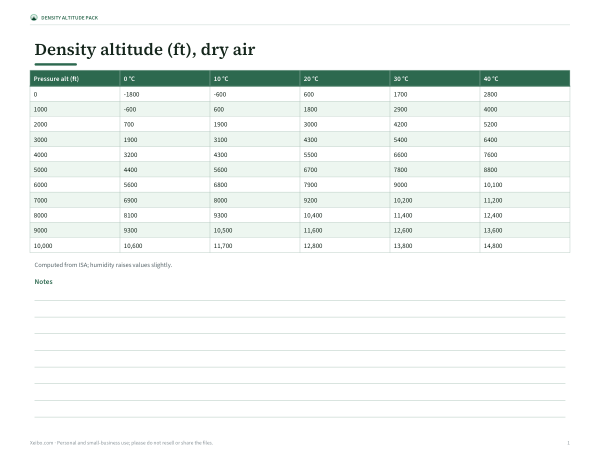
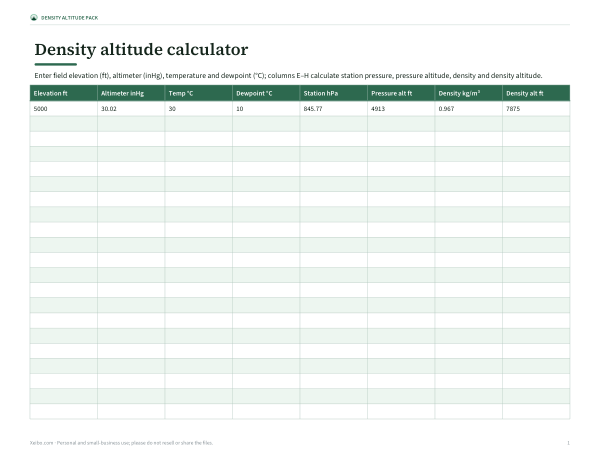
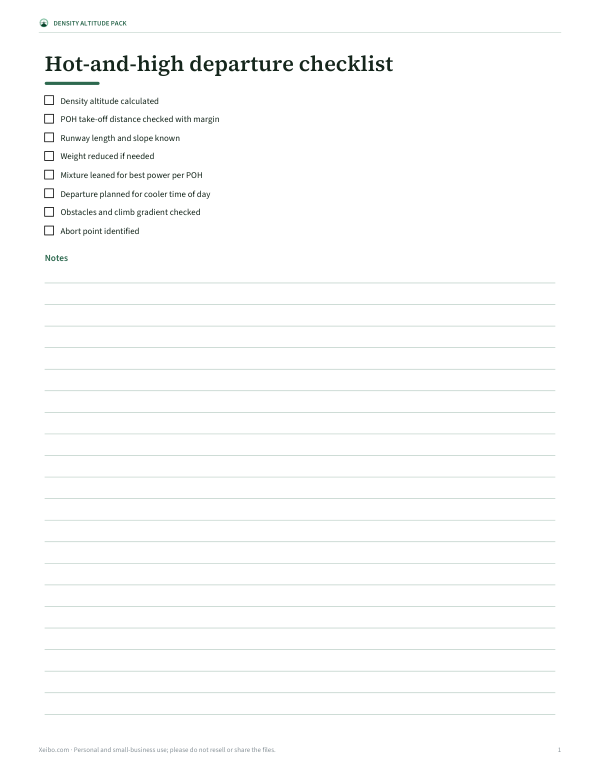
Density altitude calculator
Density Altitude Pack
Printable density altitude chart by pressure altitude and temperature, a spreadsheet calculator with humidity, a hot-and-high departure checklist and a performance planning worksheet.
- DA chart (PDF/XLSX)
- Calculator (XLSX)
- Hot and high checklist (PDF/DOCX)
- Planning worksheet (PDF/DOCX)
Formats: PDF, XLSX, DOCX. Instant download after payment (link valid 72 hours, up to 5 downloads). AI-assisted: the templates were drafted with AI help and reviewed and laid out before publishing.
$3.00 USD, one-time 4 files · about $0.75 each
- Instant download
- 7-day refund
- Secure checkout by Stripe
7-day money-back guarantee. Full refund within 7 days of purchase, even after you download.
Free sample: Density Altitude Calculator (PDF, 57 KB)
Full refund within 7 days — see the refund policy and license.
Free printables
Single sheets you can print right now, no sign-up. The full pack adds every sheet in one download plus the editable files.
 Density Altitude Planning Worksheet
What density altitude means
Density altitude is pressure altitude corrected for non-standard temperature (and, strictly, humidity). It is the height in the International Standard Atmosphere at which the air would have the same density as the air you’re actually in. Wings produce less lift, propellers less thrust and naturally aspirated engines less power as density falls, so a high density altitude means longer take-off runs, slower climbs and reduced margins.
How it’s calculated
- Convert the altimeter setting and field elevation to station pressure.
- Pressure altitude = the ISA altitude with that pressure (roughly elevation + (29.92 − altimeter) × 1,000 ft).
- Find the vapour pressure from the dewpoint, then the density of the moist air from station pressure and temperature.
- Density altitude = the ISA altitude with that density: 145,442 × (1 − (ρ ÷ 1.225)^0.235) ft.
The pilot’s rule of thumb, density altitude ≈ pressure altitude + 120 ft × (OAT − ISA temperature), usually lands within a few hundred feet of the full calculation. It ignores humidity, which adds a little on humid days, and uses a simplified temperature factor, so the two can differ in either direction.
Worked example
An airport at 5,000 ft reports an altimeter setting of 30.02 inHg, 30 °C and a dewpoint of 10 °C. Pressure altitude is about 4,913 ft, where the standard temperature would be about 5 °C — so today is about 25 °C warmer than standard. The calculator gives a density altitude of about 7,876 ft; the rule of thumb gives about 7,880 ft. The aircraft will perform roughly as it would at 8,000 ft on a standard day.
Why heat, height and humidity matter
| Factor | Effect on density altitude |
|---|---|
| Higher elevation | Lower pressure → higher DA |
| Lower altimeter setting | Lower pressure → higher DA |
| Higher temperature | Less dense air → higher DA (roughly 120 ft per °C above standard) |
| Higher humidity | Water vapour is lighter than dry air → slightly higher DA |
Hot summer afternoons at mountain airports are the classic high-density-altitude situation; early mornings are usually better for departures.
Performance rules of thumb
- Naturally aspirated piston engines lose roughly 3% of power per 1,000 ft of density altitude.
- Take-off distance can increase dramatically — often doubling at high density altitudes compared with sea level for light aircraft.
- Climb rates fall; some aircraft may barely climb on the hottest days at high fields.
- True airspeed for a given indicated airspeed is higher, so ground roll is longer.
- Use the POH performance charts, which are based on pressure altitude and temperature — not on these rules of thumb.
Density altitude at well-known high airports
| Airport elevation | Standard day (15 °C at sea level) | Hot day (+20 °C above standard) |
|---|---|---|
| 2,000 ft (ISA 11 °C) | 2000 ft | 4300 ft |
| 5,000 ft (ISA 5 °C) | 5000 ft | 7300 ft |
| 7,000 ft (ISA 1 °C) | 7000 ft | 9300 ft |
| 9,000 ft (ISA -3 °C) | 9000 ft | 11300 ft |
Values computed with this calculator for dry air at a 29.92 inHg altimeter setting. A 20 °C hotter-than-standard day adds well over 2,000 ft of density altitude at every elevation.
Pressure, altimeter setting and station pressure
The altimeter setting reported by weather stations (QNH) is the pressure reduced to sea level so that an altimeter shows field elevation on the ground. The actual pressure at the airport — station pressure — is lower at high fields. This calculator converts the altimeter setting back to station pressure using the standard formula, then uses it with temperature and humidity to find the air density. At a 5,000 ft field, a 30.02 inHg altimeter setting corresponds to a station pressure of only about 845 hPa.
Reading a density altitude chart
- Find the pressure altitude — set 29.92 on the altimeter, or correct field elevation for the altimeter setting.
- Find the outside air temperature on the bottom axis.
- Move up to the pressure altitude line.
- Read the density altitude on the side axis.
- Use that value with the aircraft’s performance data where the charts ask for it — many POH charts instead use pressure altitude and temperature directly.
Beyond aviation
Density altitude also matters for car engines (turbocharged engines are less affected), drones and helicopters, long-range shooting, and ball flight — baseballs and golf balls travel farther in thin air, which is why altitude is often mentioned when talking about hitting at high-elevation stadiums.
Privacy
All calculations run in your browser.
Frequently asked questions
What is density altitude?
Pressure altitude corrected for temperature (and humidity): the ISA altitude with the same air density.
How do I calculate density altitude quickly?
Pressure altitude + 120 × (OAT − ISA temperature) in feet.
Does humidity affect density altitude?
Yes — humid air is slightly less dense, raising density altitude a little.
What is pressure altitude?
The altitude in the standard atmosphere with today’s pressure; set 29.92 inHg on the altimeter to read it.
Why is high density altitude dangerous?
Aircraft need more runway and climb more slowly.
Can I use this for flight planning?
Use it to learn and cross-check; rely on your POH and official weather.
What is ISA?
The International Standard Atmosphere: 15 °C and 1013.25 hPa at sea level, cooling about 2 °C per 1,000 ft.
Why does the rule of thumb differ from the calculator?
It ignores humidity and uses simplified lapse rates.
Does density altitude affect turbocharged engines?
Less for engine power up to the critical altitude, but wings and propellers are still affected.
What is a “high” density altitude?
It depends on the aircraft; many light aircraft performance charts show large penalties above about 5,000–8,000 ft.